


Contact our offices
Main office
COLBURN
5 & 6 BAILEY COURT
COLBURN BUSINESS PARK
RICHMOND
NORTH YORKSHIRE
DL9 4QL
Estate Agency Offices are located in
BARNARD CASTLE, BOROUGHBRIDGE & RICHMOND
Residential Management Team
Our Offices
- Alnwick
01665 568310
Email Officealnwick@gscgrays.co.uk - Barnard Castle
01833 637000
Email Officebarnardcastle@gscgrays.co.uk - Boroughbridge
01423 590500
Email Officeboroughbridge@gscgrays.co.uk - Chester-Le-Street
0191 3039540
Email Officechester-le-street@gscgrays.co.uk - Colburn
01748 897630
Email Officecolburn@gscgrays.co.uk - Driffield
01377 337180
Email Officedriffield@gscgrays.co.uk - Hamsterley
01388 487000
Email Officehamsterley@gscgrays.co.uk - Hexham
01434 611565
Email Officehexham@gscgrays.co.uk - Kirkby Lonsdale
01524 880320
Email Officekirkbylonsdale@gscgrays.co.uk - Penrith
01768 597005
Email Officepenrith@gscgrays.co.uk

To drill or not to drill?
Considerations as increased fertiliser and fuel costs shape Autumn 2026 cropping plans
Autumn drilling decisions in 2026 are being shaped by a familiar but still uncomfortable combination of elevated fertiliser costs, volatile fuel prices and cautiously firmer grain markets. While the outlook appears more manageable than it did earlier this spring, this is a year where cropping decisions must be driven by margin discipline rather than habit or optimism.
Several key questions need to be considered:
- Which crops will give a consistent profitable margin?
- Which crops are too risky to grow?
- Which crops can you maintain margin whilst reducing costs?
- Which fields will give a consistent profitable margin?
- Which fields are too risky to crop?
- What fields can you maintain margin whilst reducing costs?
A more stable picture
There have been some welcome developments. The reduction in red diesel duty — from 10.18p/litre to 6.48p/litre — provides modest relief on machinery running costs through to the end of 2026. In practical terms, an efficient operator will use around 50 litres/acre in growing a winter crop (excluding drying), equating to a saving of just under £2/acre. While relatively small in isolation, a more significant cost saving may be achieved where fuel use can be reduced to around 40 litres/acre without compromising performance.
Output markets are also offering more support. Feed wheat for late 2026 is trading around £180–£190/t, while oilseed rape remains in the high-£400s/t (including bonuses). This represents an improvement on earlier uncertainty but must be viewed alongside a cost base that remains structurally high.
The focus should therefore be on ensuring that crop choice and field selection deliver acceptable returns this year, without compromising future profitability. Some cropping decisions may appear financially viable in the short term but could restrict future rotation options and reduce longer-term returns. Ensuring a consistent return year-on-year, should be part of the decision-making process.
The margin game-changer
Fertiliser is the single biggest factor shaping autumn drilling decisions.
With ammonium nitrate around £530/t and urea above £600/t, prices remain materially above pre-crisis levels. Applied at previous rates, this adds approximately £40–£50/acre to a typical cereal crop, compared with recent seasons.
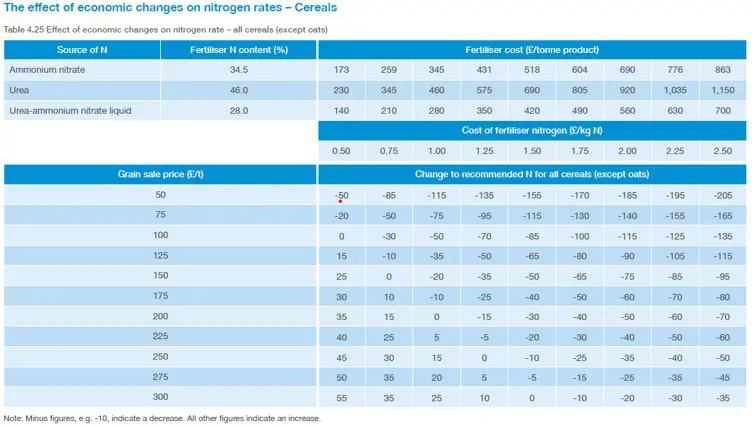
The starting point must therefore be to recalculate optimal fertiliser usage based on fertiliser and crop prices for Harvest 2027. AHDB’s RB209 booklet provides useful data to help you undertake these calculations (see above).
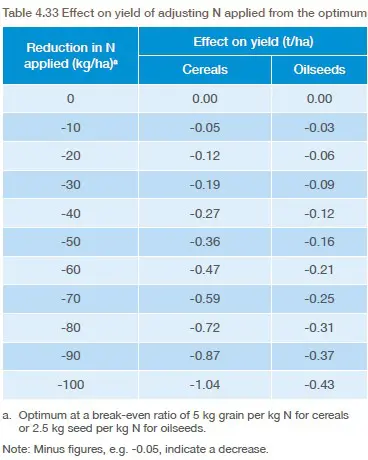
Depending on your actual prices, the likelihood is that the nitrogen rate is going to be around 30-40 kg/ha less than the norm. Yes, it will reduce yield, but by much less than most people think, as shown in the following table from the RB209 booklet:
Better utilise organic manures
Consideration should not be limited to “bagged” fertiliser. Greater use of organic manures can improve nutrient utilisation and enhance uptake efficiency. Applying manures to growing crops, rather than spreading them on the stubble prior to sowing, can achieve significant cost savings, whilst also reducing the risk of pollution.
Build realistic gross margins
Adjusting the fertiliser approach allows more realistic gross margins to be developed across all cropping and SFI options. This provides an opportunity to review the rotation and identify where changes could improve returns.
- Currently the most profitable crops are 1st Wheats and Winter Oilseed Rape (WOSR). Can the rotation be altered to increase the area of these crops, especially now there are strategies in place to reduce the risk of Cabbage Stem Flea Beetle in WOSR?
- At the same time can you minimise the area of low margin/higher risk cereal crops (2nd Wheats, Winter Barley, Winter Oats)?
- If you have legume fallow in the rotation is now the time to bring those fields back into production and sow a 1st Wheat?
- Might it be appropriate to grow pulses (beans and peas) that have no Nitrogen fertiliser requirement? It is accepted that the margins are not attractive but if they are not substantially less than 2nd Wheats or W Barley, consider growing those as they will enable a 1st Wheat to be sown next year.
A well thought through rotation is likely to have 60-65% of the cropped area in the higher-margin crops such as 1st Wheat and WOSR. For the remaining 35-40%, SFI options should be considered alongside cropping. Legume fallow, for example, may well have a place instead of a low margin cereal crop. It could well produce a similar margin but provides an entry to a high margin 1st Wheat the following year. It is evident that legume fallow that has been in place for two years improves the soil health significantly, and sowing in early September means the 1st Wheat should have good yield potential, even on a poor field.
Take account of field variations
Crop margins also need to reflect the variations between fields across the farm. Certain fields may be too heavy for spring crops or too light for 2nd Wheats, requiring different rotations in certain areas. The aim remains the same – to ensure a margin that is financially acceptable this year, without compromising future profitability.
For the poorest fields it may be more beneficial to utilise SFI options more frequently, with a cash crop grown perhaps one year in three. This enables a reasonable return to be achieved through the SFI option, followed by a higher-margin, lower-risk cash crop when circumstances are right to do so.
Review fuel usage across crops & fields
Fuel cost pressures have eased, but they remain a live issue. Even after duty reductions, red diesel prices are still well above long-term averages and remain exposed to volatility and potential supply disruption during peak periods.
In practical terms, cultivation-heavy systems continue to carry a higher cost burden. A poorly thought through rotation can delay establishment, increase fuel use and put additional strain on labour and machinery at critical times. Inefficient operations, whether through unnecessary passes or poor timing, can erode margins by £20–£50 per acre.
In a tight margin year, system choice can be as important as crop choice.
A practical decision framework
To navigate this season, businesses should take a structured approach:
- Update costings using current fertiliser and fuel prices and recalculate optimal fertiliser use for each crop, including better utilisation of organic manures where available.
- Build realistic gross margins for all crops and SFI options, ideally on a field-by-field basis.
- Stress-test scenarios including yield reductions, cost increases and price softening.
- Prioritise crops grown and land sown based on consistent performance.
- Decide deliberately, drilling where margins are resilient and utilise SFI options where they are not.
The strategic view
The overall position is more stable than many had feared earlier in the year. Fuel costs have eased slightly, grain markets have strengthened, and input availability remains manageable for the time being. However, the underlying risks have not disappeared. Fertiliser prices remain elevated, input markets continue to show volatility, and margins are consequently more sensitive than in recent seasons.
Margin over momentum
Autumn drilling in 2026 is less about maximising cropped area and more about protecting margin while limiting downside risk. The most resilient businesses will be those that understand their true cost of production, align cropping decisions with field performance, and treat inputs as strategic investments rather than a fixed requirement.








Client Feedback
We have had the pleasure of serving a variety of clients...
We received excellent service and were well informed at each stage of the process. We were pleasantly surprised when Kate whooped down the phone when she received the key for Golden Lion Mews! We would have no hesitation in giving you and the team 5 stars for service.
Mr and Mrs Marron
Client Feedback
We have had the pleasure of serving a variety of clients...
GSC Grays provide an experienced and professional service. From the initial contact with the valuer (Graham Wood) to the closure of the sale they keep you informed throughout. Graham and all of the staff are a pleasure to deal with. I would highly recommend them. I would also give you a 5 star rating.
Marian Lowe
Client Feedback
We have had the pleasure of serving a variety of clients...
I unhesitatingly recommend Gray’s Estate Agent in Barnard Castle. We explored a number of agents and chose GSC Grays not because they were the cheapest but because they most inspired our confidence. We were not disappointed; from the initial visit through various stages to completion we were impressed by the professionalism, attention to detail, excellent communication, competent negotiation, and willingness to go the extra mile in customer service. They facilitated the sale of our property in a way that made it feel a pleasure to sell.
H. Thorp
Client Feedback
We have had the pleasure of serving a variety of clients...
We have moved house several times over the years so feel well qualified to recognise good efficient service when we see it. All the way through, from the initial valuation to the day of completion, everyone at GSC Grays made us feel our sale really mattered. We were kept well informed of the progress of the sale and any questions we had were answered promptly and clearly. We would definitely recommend GSC Grays to anyone planning to buy or sell a property.
M. Scarborough
Client Feedback
We have had the pleasure of serving a variety of clients...
Thank you once again for the excellent care you have taken of us during the sale and now the purchase of our house. We have felt all along that you really cared and were really interested. A wonderful service.
A. Merck
Client Feedback
We have had the pleasure of serving a variety of clients...
Thank you for all your help during our move. It all got quite stressful towards the end and it was great to have you at the end of the phone offering reassurance and advice. We got there in the end and we are delighted with our new home! Just wanted to let you know how much your help was appreciated!
Katy
Client Feedback
We have had the pleasure of serving a variety of clients...
I just wanted to pass on my appreciation to the whole team for the fantastic job they did for me. The Sales Progression team had a particularly tricky job as the sale was less than easy but they were all amazing.
G.F
Client Feedback
We have had the pleasure of serving a variety of clients...
GSC Grays were recommended to me and in the years which I have worked with them, I have found their approach excellent. They take a long term view and provide exactly the right balance between pushing things on whilst keeping me informed – I am delighted to have them on board.
C.C
Client Feedback
We have had the pleasure of serving a variety of clients...
Excellent HomeBuyer Report service. Survey completed promptly and initial comments delivered by telephone within twenty-four hours with comprehensive written report received by post shortly after. Clear, concise documentation, which includes advice on rectifying defects and issues that legal advisors may wish to investigate, all professionally presented in a bound booklet enabling a timely informed decision to be achieved in respect of the purchase of the property. Thoroughly recommended.
A. Longstaff
Client Feedback
We have had the pleasure of serving a variety of clients...
GSC Grays have always provided a professional and friendly letting service for me. Their regular updates and communication have meant total peace of mind that my properties are being managed with the up most of care. I would definitely recommend GSC Grays to other landlords.
M.M
Client Feedback
We have had the pleasure of serving a variety of clients...
When your largest cost in selling/purchasing a new house is the estate agent fees it is a rather large cost to accept, especially with things like Rightmove been involved. However, once my sale was agreed and it was passed over to Catherine in the sales progression team I do believe the fee was easier to stomach as her role in the sale/purchase was worth its weight in gold, and without it, there is no doubt in my mind that things would have not got done in the timescales we and our seller wanted. I really do appreciate all of Catherine’s advice and help in keeping the whole process moving.
E. Sword
Lycetts
Client Feedback
We have had the pleasure of serving a variety of clients...
Thank you so much to the Barnard Castle Branch and the Sales Progression team for all your help with the purchase of our new home. We are absolutely delighted with the property and were really impressed by the service and experience we had at GSC Grays.
H. Langford
Client Feedback
We have had the pleasure of serving a variety of clients...
Thank you to everyone at GSC Grays for your friendly professionalism over the past two years and especially in more recent weeks. I greatly appreciated all you do and would have no hesitation in recommending you to anyone!
J.N
Client Feedback
We have had the pleasure of serving a variety of clients...
GSC Grays were recommended to me and in the years in which I have worked with them, I have found their approach excellent. They take a long term view and provide exactly the right balance between pushing things on whilst keeping me informed – I am delighted to have them on board.
A.N
Client Feedback
We have had the pleasure of serving a variety of clients...
Theakston Land has worked with Calum and his team for many years. That work has included a detailed analysis of costs to maximise value. The development appraisal work undertaken with GCS Grays means that I am confident we are getting the best possible price. They make a positive contribution at all levels and help to drive forward long term and complex development projects.
S Marlow
Theakston Land
Client Feedback
We have had the pleasure of serving a variety of clients...
During 2020 Holly Story has worked on Barningham Estate helping us in our understanding of Natural Capital assets. Holly was instrumental in Barningham’s successful ELMs Test and Trial bid and is leading in the bid’s implementation. Her understanding and thought leadership are helping to bring clarity and good sense to what seems an increasingly complicated agricultural world.
Sir Edward Milbank
Barningham Estate
Client Feedback
We have had the pleasure of serving a variety of clients...
We have been working with GSC Grays Farm Business team since 2018 and with Robert Sullivan for over 20 years. The advice and insight of the team has been invaluable and means that we are now in a much stronger position to face the future and the changes in the industry with confidence. Their passion and commitment to us and the farm is integral to our success.
T. Dent
Dinsdale Farming Ltd.
Client Feedback
We have had the pleasure of serving a variety of clients...
We could not have chosen a better estate agent. Excellent work from start to finish from all the well-motivated professionals with whom we came into contact. The house was well marketed, and communications were superb, we were always kept well informed.
Mrs A
Keep up to date
Register for our newsletters to receive the latest information on our services, the industry, and our own company news.
Subscribe to our newsletter




© COPYRIGHT GSC GRAYS LIMITED
TRADING AS GSC GRAYS (ENGLAND AND WALES). COMPANY REGISTRATION NUMBER: 07715034.
REGISTERED OFFICE ADDRESS:
1 BAILEY COURT, COLBURN BUSINESS PARK, RICHMOND, NORTH YORKSHIRE DL9 4QL

Contact our offices
Main office
COLBURN
5 & 6 BAILEY COURT
COLBURN BUSINESS PARK
RICHMOND
NORTH YORKSHIRE
DL9 4QL
Estate Agency Offices are located in...
BARNARD CASTLE, BOROUGHBRIDGE & RICHMOND
Residential Management Team
Our Offices
- Alnwick
01665 568310
alnwick@gscgrays.co.uk - Barnard Castle
01833 637000
barnardcastle@gscgrays.co.uk - Boroughbridge
01423 590500
boroughbridge@gscgrays.co.uk - Chester-Le-Street
0191 3039540
chester-le-street@gscgrays.co.uk - Colburn
01748 897630
colburn@gscgrays.co.uk - Driffield
01377 337180
driffield@gscgrays.co.uk - Hamsterley
01388 487000
hamsterley@gscgrays.co.uk - Hexham
01434 611565
hexham@gscgrays.co.uk - Kirkby Lonsdale
01524 880320
kirkbylonsdale@gscgrays.co.uk - Penrith
01768 597005
penrith@gscgrays.co.uk
Or please fill in your details below and one of our team will get back to you as soon as possible.